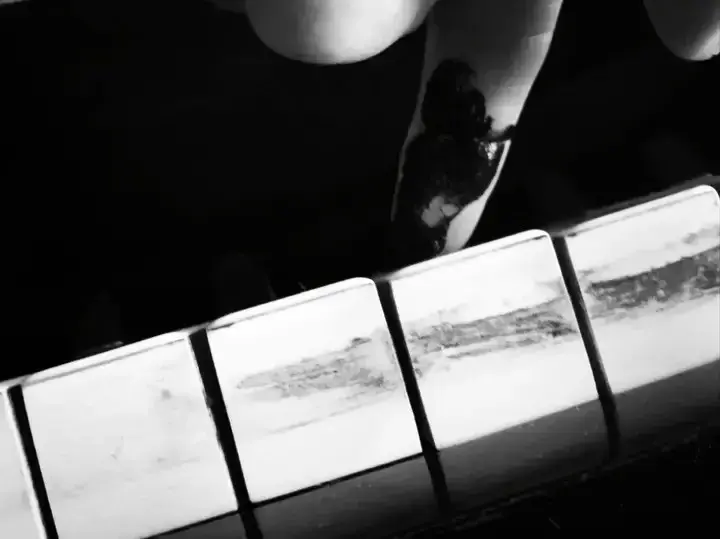
The next opportunity to see the work of Anna Laura Longo will be at the Polytechnic University of Valencia (UPV), where a copy of *Materializaciones poéticas / El residuo es Forma* has arrived in the Library. The work also includes a sound component, specifically an original audio contribution to be listened to. The library in question is an integral part of the Faculty of Fine Arts (address: Camino de Vera, Building 3L, Ground Floor, Valencia). The work currently in Valencia was also presented as part of the second edition of the international interdisciplinary Congress "Cuerpos, materias y otros restos," also organized in Spain, at the UAM - Autónoma University of Madrid (Faculty of Philosophy and Letters).
The desire is to produce a transformation, sometimes subtle but other times striking, of more or less usual methods or approaches, in order to reactivate mental pathways and predispose minds in such a way that a truly metamorphic direction can be followed. What is facilitated and encouraged is not, in fact, a change for its own sake, but a change "of depth." Everything clearly leads towards composite reflections concerning the human evolutionary process. Anna Laura Longo's artistic path is characterized by a combination of musical, textual, performative, and artistic-visual elements. It is a multifaceted practice in which sound and visual research merge with forms of innovative writing, sometimes truly abstract or developed using heterogeneous materials.
The latter are generally manipulated freely with the aim of forming a mélange of situations, often with an organic and truly material connotation. To this naturally adds the pianistic and sound research. In fact, Longo has developed an autonomous conceptual proposal, with respect to writing, to musical practice itself, and to the performative act itself, gradually arriving at a design and construction of very detailed artistic-visual volumetries (micro and macro) to be placed close to supports and surfaces of various types in such a way as to create book-organisms and very captivating multimaterial works assisted by sound contributions. What he proposes is therefore a possible facilitation of expanded sensory responses. The whole aims at activating mnemonic responses alongside sensory responses and traces.
We are essentially faced with a 'summation' of experiences where continuous comparisons and reconciliations between opposites prevail, for example between temporality and atemporality, between reality and unreality, between smoothness and roughness, both from a sound and mainly pianistic perspective (with particular reference to the texture of sounds), and from an artistic-visual point of view. And it is precisely visually that the manipulation of flat surfaces leads to page-territories constructed according to an unprecedented and research-oriented design. Pianistically as well, this manipulation has its own specific prominence and concerns the sound aspect, in particular the use of the musical instrument in a broad sense but, above all, the way in which performative actions can be designed and rendered.
For this purpose, keyboards or strings defined as "volumetric" are often prepared, through a provisional insertion of objects and material contributions, often the result of self-design, and thanks to which actual sounds or installation systems can be created, with the addition of performative and innovative gestural elaborations.
The approach therefore tends to go beyond traditional boundaries. In recent years, interest has grown in synesthesia, misdirection, conceptual overturning, "digression" as a form of methodological setup, and also the study and application of transversal comparisons between aesthetics and artistic languages, to trigger a true co-evolutionary discourse.
Specifically, a co-evolution of languages is facilitated to provide an expansion of experiences.