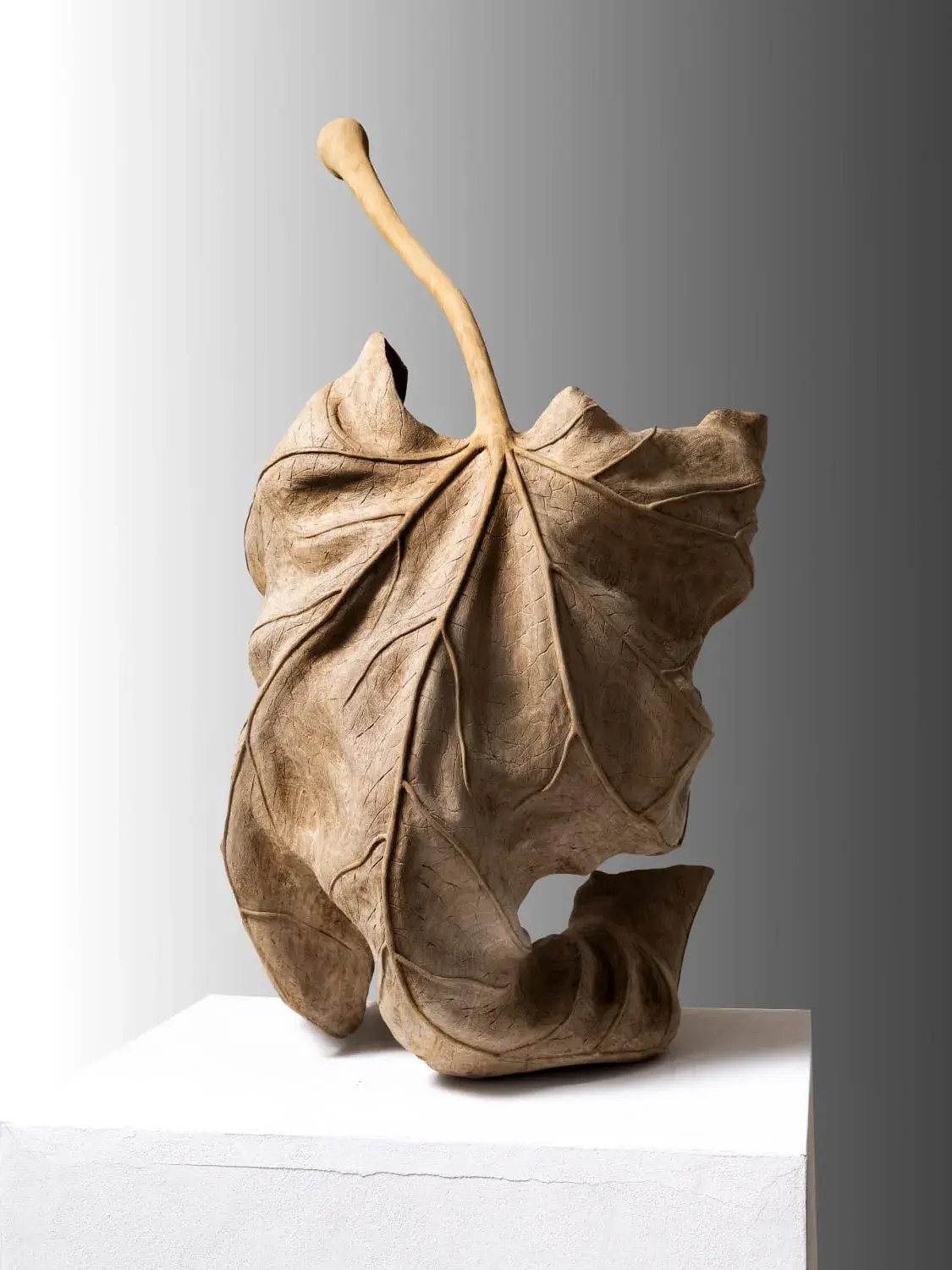
At Blue Gallery in Venice, from September 26 to October 26, 2026, the exhibition Restante presents four sculptures by Antonio Tropiano, a Calabrian artist whose singular background brings together philology, art history, and the tradition of wood sculpture.
Curated by Alberto Dambruoso and Silvio Pasqualini, with a poetic text by Teresa Murgida, the exhibition highlights a practice in which the technical precision of working with wood becomes a means of questioning the present.
Dambruoso describes Tropiano as an artist capable of «skillfully and harmoniously combining thought and form», bringing the tradition of wood sculpture to «an exceptionally high degree of compositional rigor». His works often begin with simple, recognizable forms — a fig leaf, a beehive, a coat rack, a paper bag — and transform them into images charged with meaning.
The title Restante refers to the idea of what survives through subtraction: the fragment, the discarded element, what remains after the sculptor’s chisel has done its work. For Tropiano, sculpture is a «field of infinite possibilities», while emptiness does not represent absence, but rather a space still open to what might emerge.
The four works in the exhibition address deeply contemporary themes. Edenismi reflects on the difficulty of distinguishing truth from falsehood in the age of global information and artificial intelligence; Appendihabitat explores the fragility of community through the metaphor of a beehive hanging from a coat rack; Metà Morfosi stages, with grotesque irony, the transformations of human beings immersed in a technological and hyperconnected society; finally, Cenoscopio invites viewers to look inside an empty paper bag, turning emptiness itself into a reflection on the possibility of containing.
«His sculptures act as devices», Dambruoso writes, capable of «stimulating the emergence of a critical consciousness in the viewer».
It is precisely this relationship between thought and matter that has drawn Silvio Pasqualini to Tropiano’s work. He recognizes in him a rare kind of artist, one whose humanistic education directly informs his practice. «Today, the artist must be an intellectual», Pasqualini states, and Tropiano «sculpts language, time and memory».
Rooted also in the family heritage of his grandfather, a cabinetmaker and carpenter, Tropiano’s practice reasserts the centrality of the hand and of human agency, bringing tradition into dialogue with contemporary art.