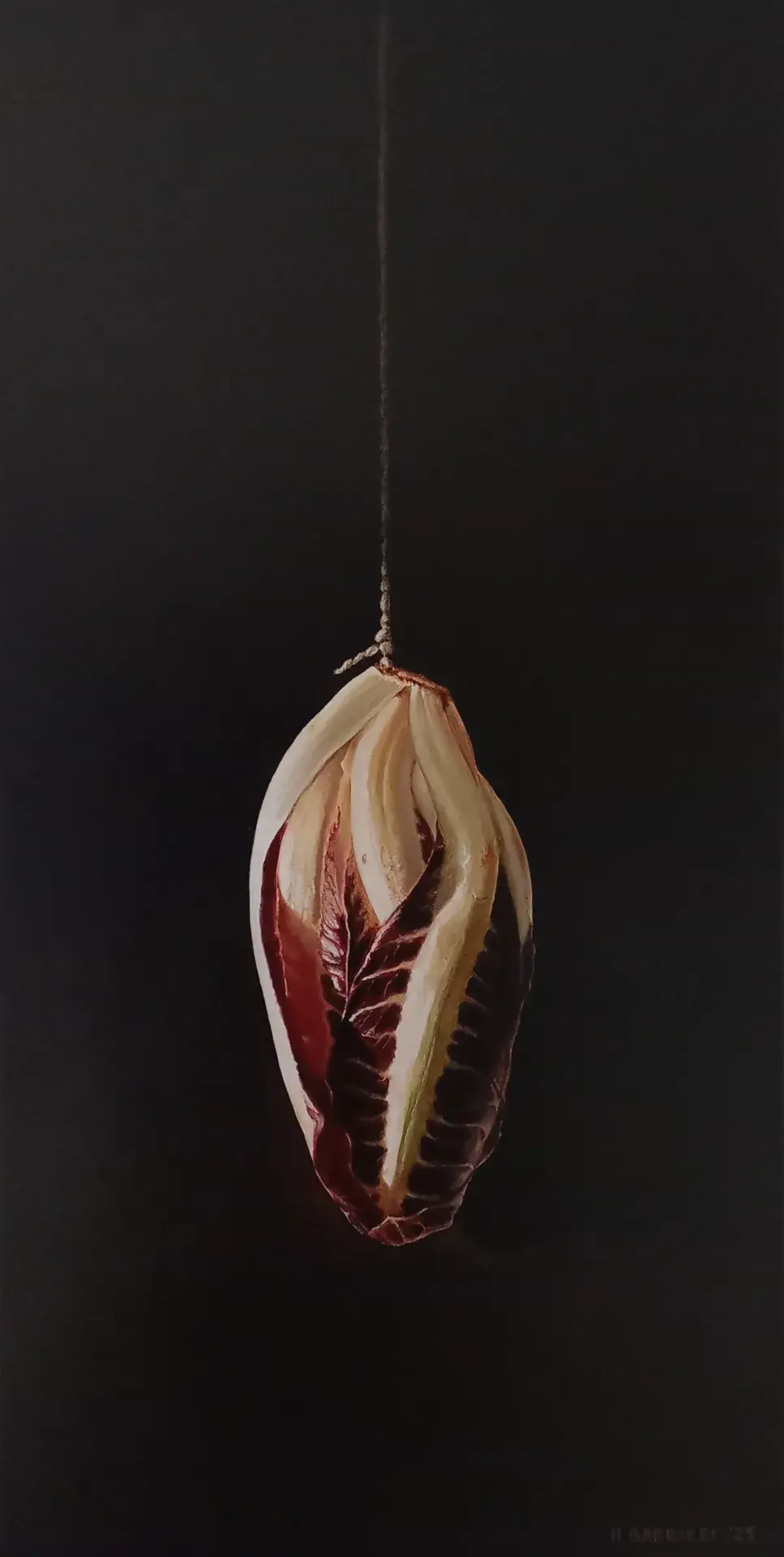
Hervé Barbieri is firmly situated within the creative ferment of Postmodernism, thanks to his deliberate choice to revive a figurative language by looking to historical precedents from various eras. However, he
avoids mere quotation, instead reinterpreting these influences by infusing them with contemporary forms and color palettes.
His works are poetic, sophisticated, and refined.
The subjects move beyond mere photographic representation, opening up to solutions of great technical
skill that—where appropriate—engage in a dialogue with informal applications of color.
The depicted moment—captured in a specific light, amidst the interplay of forms, masses, colors,
reflections, and shadows—creates a tension akin to a poetic act, grounded in a silence that conveys
intense emotion.
In these suspended moments, one perceives the natural beauty of the subjects, rendered through
masterful, deliberate framing—never accidental—that celebrates their elegance with quiet detachment.
His artistic technique is also the result of extensive research. Traditional oil painting on canvas and panel
alternates with works inspired by Renaissance graphic art—using pencil and mixed media on paper mounted on canvas or panel—creating an evocative blend of the ancient and the contemporary: quintessentially Postmodern.
The introduction of geometric and formal elements—abstract in their coloring, and at times bold—draws us into an intense dialogue between tradition and the contemporary.
Barbieri works in thematic series (tree bark, leaves, wild plants, still lifes, shadows, vegetable gardens) that intertwine, echoing one another in endless variations on a theme. These are, to all intents and purposes, poems dominated by silence, where the brushstrokes, light and reflections, turned surfaces, and the rhythm of branches and leaves speak to us.
Each panel or canvas serves as a starting point and a point of balance from which the artist oscillates at will between visual completeness and *informel* abstraction, between natural subject and geometric-conceptual form, and between classical composition and decorative abstraction.