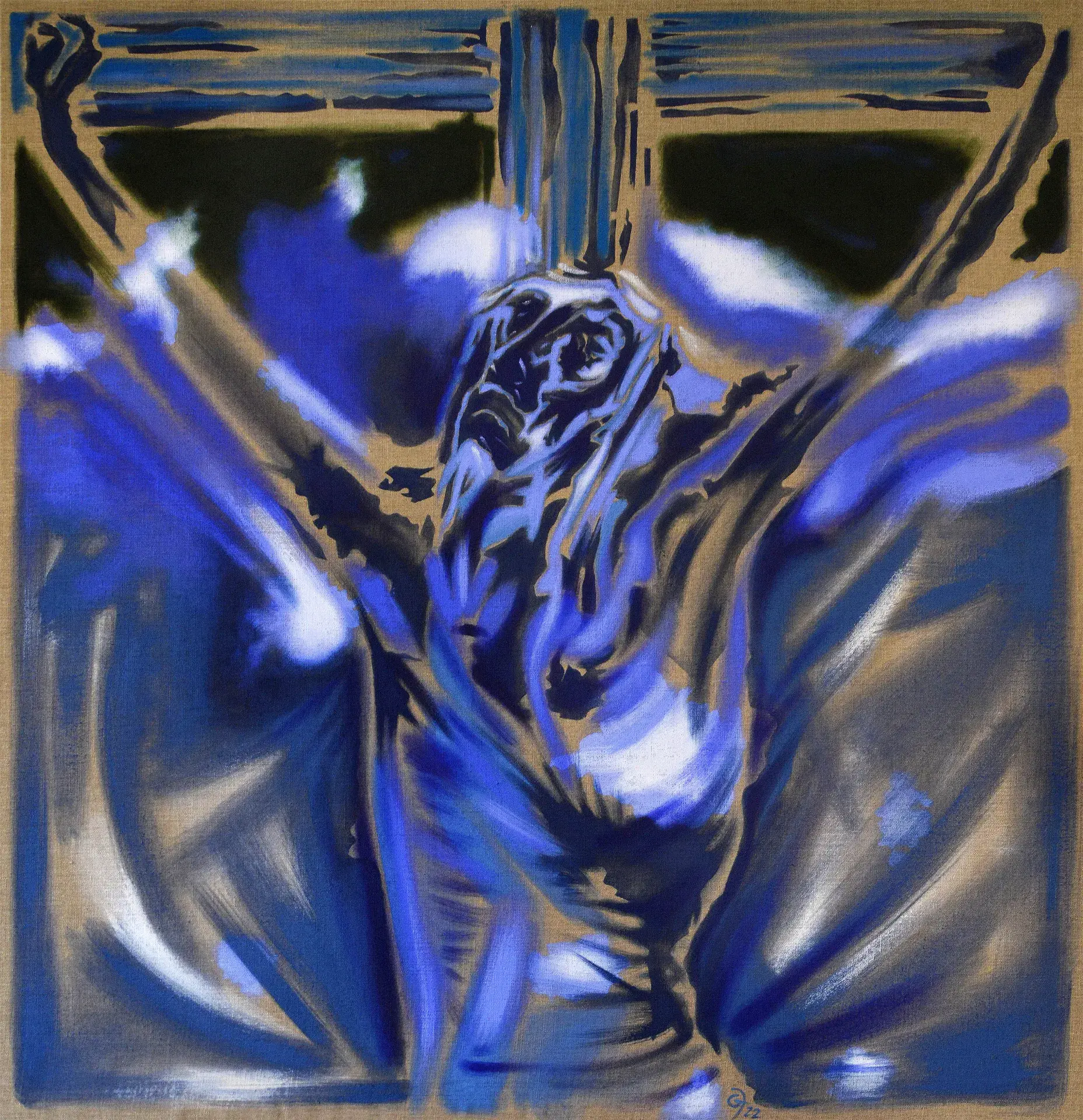
"Painting as a Mode of Observation." From March 15 to April 12, 2026, the Porta del Cielo exhibition space in Treviglio hosts an exhibition with a powerful spiritual impact: Gaetano Fiore's homage to the Pointillist master Gaetano Previati.
On the occasion of the Zenalian Year, established to commemorate the 500th anniversary of the death of Bernardo Zenale, whose San Martino polyptych embodies the rigor of the Lombard Renaissance, the exhibition engages with and embraces this spiritual legacy, transfiguring it through contemporary language. Gaetano Fiore's exhibition is a visual pilgrimage that reconnects the threads of European sacred tradition—from Previati to Sutherland—filtering them through the existential lens of Rainer Maria Rilke.
Fiore operates like an astronomer of the inner sky who, using a powerful microscope, makes the elusive visible: the spiritual that becomes a figure in the Cross, the Tree of Life. Strong in impact, almost dramatic and at times spectral, Fiore's painting harks back to an ancient modernity emerging from the submerged. The pictorial references now turn to Previati and Sutherland, within the context of a new, dynamic spatialism. Color is immanent, total. The fabric absorbs light and vibrates.
The exhibition
• 14 Icon-Caskets (Via Crucis): An installation where traces of silver on paper and smooth driftwood come together in an "architecture of pain." The branch becomes a three-dimensional graphic sign that traverses the sacred space, evoking the Rilkean object (the Dinggedicht), which in its humility contains a divine essence.
• The work "Crucifige": A monumental Crucifixion where a burst of cobalt blue shatters the silence of the drawing. The filamentous brushstroke transfigures the body of Christ in a light that "does not console, but digs," recalling the lesson of Sutherland, where the sacred drama becomes organic and almost vegetal.
Between the secrets hidden in the treasure chests and the luminous scream of the large canvas, the viewer is invited to rediscover the sacred not as dogma, but as a living, tactile, and profoundly human presence.