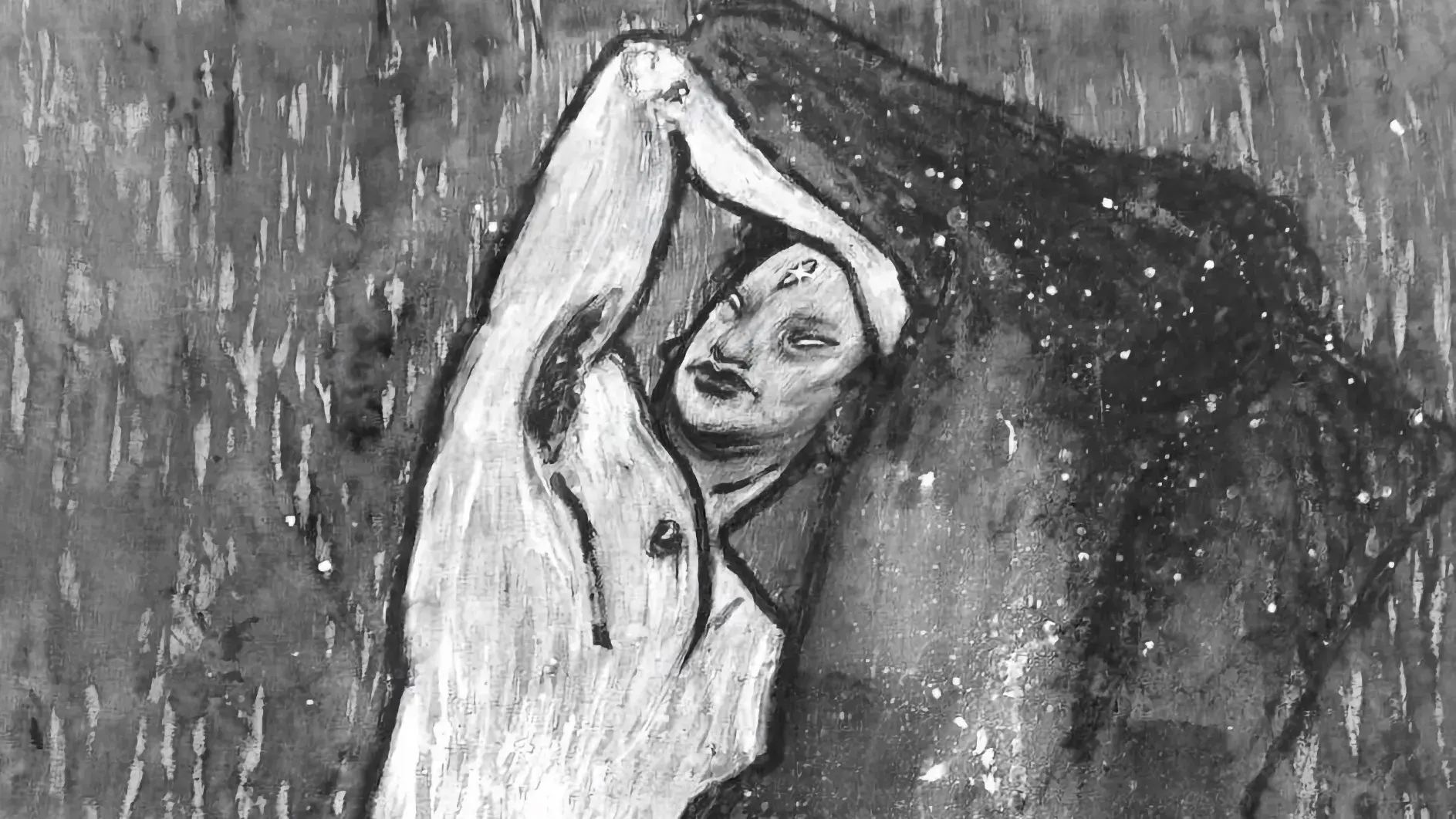
Self-Mythology is a project that takes shape as a visual and symbolic investigation of masculinity, built through a series of monochrome painted cloths made on domestically used fabrics. The use of black and white acrylic, applied without completely concealing the weave of the textile, makes the surface an active, vibrating element of the image: the cloth is not a mere support, but a body in itself, a skin that absorbs and returns the painterly gesture.
The cycle arises as a reflection on the construction of a personal, self-referential mythology. The artist stages an imaginary world in which the masculine self-represents, celebrates itself, and at the same time becomes imprisoned within its own heroic narrative. The evoked figures seem to belong to a private pantheon, where patriarchal archetypes—warrior, athlete, dominator, martyr—are isolated, reiterated, and pushed to an extreme tension, until their structural fragility is revealed.
At the base of the project lies the conceptual polarity between Dionysian impulse and Apollonian tension, according to the well-known dichotomy formulated by Friedrich Nietzsche in The Birth of Tragedy. On one side, Dionysian force appears as excess, loss of control, chaotic and desiring expansion of the body; on the other, the Apollonian instance imposes discipline, measure, and formal containment. In the cloths this oscillation never resolves into a stable balance: instead it generates suspended images, crossed by a continuous tension, as if each figure were caught in the precise moment when order risks yielding to instinct, or vice versa.
The body thus becomes the battlefield of these opposing forces. Deformed, fragmented, sometimes ambiguous in the definition of sexual traits, it takes on an unsettling and erotic dimension. Eroticism is never explicitly celebratory, but appears as compressed, restrained, or distorted energy; what emerges is a corporeality marked by traits now perceived as neurotic, repressive, and castrating. Personal mythology then reveals itself as a critical device: it dismantles from within the hegemonic narratives of masculinity, showing their performative aspect and their fragile, almost theatrical component.
The visual language—figurative yet reduced to the essential—accentuates this archetypal dimension. The exclusive use of black and white eliminates any chromatic distraction, focusing attention on contrast, silhouette, and the relationship between fullness and emptiness. The weave of the fabric surfaces as a domestic, everyday memory, introducing a further tension between intimacy and monumentality: what appears as myth is rooted in common, vulnerable materials, far from heroic rhetoric.
The flexible format of the cloths, suspended and not rigidly framed, allows a direct dialogue with the exhibition space. The works behave like mobile, adaptable presences, almost ritual. More than traditional paintings, they present themselves as contemporary tapestries: narrative surfaces that evoke archaic practices of visual storytelling and at the same time subvert them. Installed in space, the fabrics assume an environmental dimension, inviting the viewer to engage physically with images that are not only to be looked at, but to be traversed with the gaze and with the body.
In Self-Mythology, therefore, painting becomes an instrument of identity excavation and a critical device: a place where masculinity stages itself, questions itself, and fractures, ceaselessly oscillating between the desire for control and the drive toward surrender.