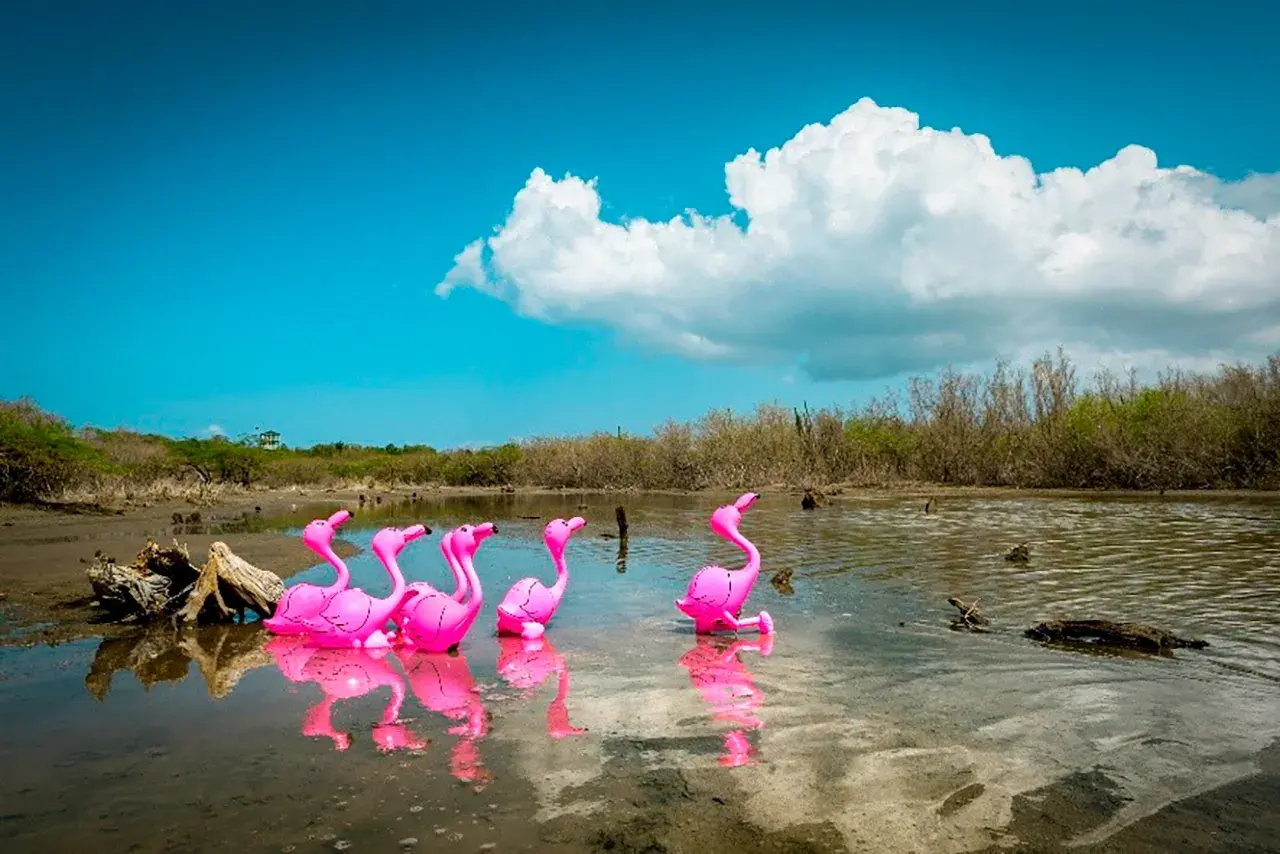
From 30 September to 8 November 2026, Milan’s Natural History Museum presents “L’Era Plasteozoica. Una distopia ecologica”, a project by the Dominican collective Pictoria Newhouse, formed by Victoria Thomen and Guadalupe Casasnovas. Presented in Milan for the first time, the exhibition enters into dialogue with the Museum’s collections and scientific instruments. Photographs, installations, drawings, artificial animals and imaginary taxonomic cards construct a future ecosystem in which animals appear to have progressively disappeared, replaced by plastic specimens. Artificial birds, insects, reptiles and marine creatures inhabit altered natural landscapes, becoming false remains and organisms of an impossible zoology. The works adopt the language of scientific classification to describe a world in which the boundary between nature and artifice, organism and waste, document and invention is no longer recognisable. Plastic is presented not only as a polluting material, but as a substance capable of persisting, integrating into environments and becoming one of the most enduring traces left by human beings on the planet. Originating from a photographic expedition to Laguna de los Flamencos on the island of Saona in the Dominican Republic, the project asks whether humanity may be forced to manufacture its own fauna in order to represent it. It imagines a new era, not recognised by geology, in which plastic has become landscape, habitat, false organism and a possible fossil of human civilisation. The exhibition places the artworks alongside specimens from the Museum’s collections: a taxidermied flamingo and two Dominican reptiles preserved in alcohol, sent in the 1930s by the Agronomic Station of Moca. The exhibition is part of TRACCE, the first of four thematic sections in the multidisciplinary programme promoted by the Scientific Institutes of the Municipality of Milan and dedicated to dialogue between science and art.