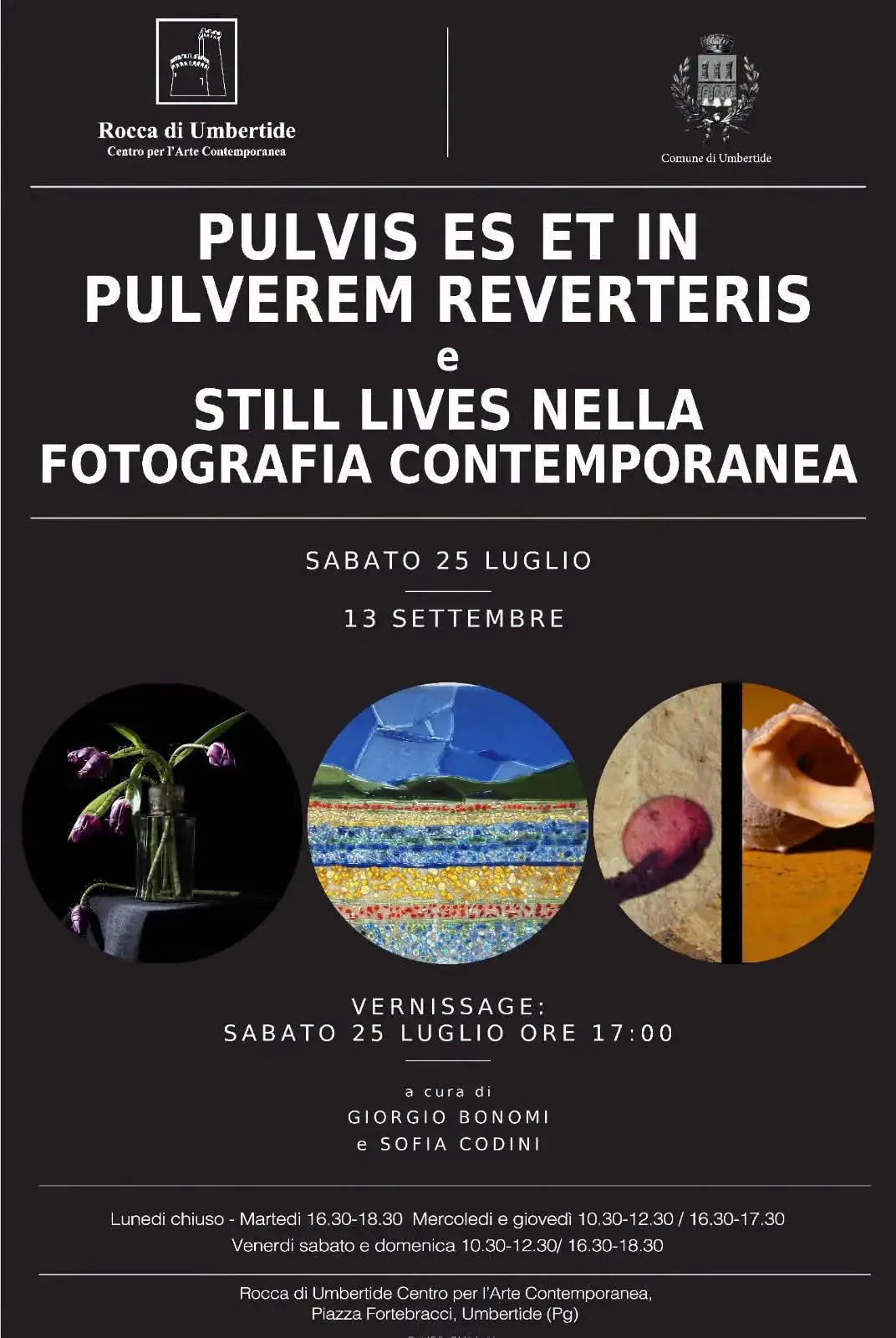
PULVIS ES ET IN PULVEREM REVERTERIS AND STILL LIVES IN CONTEMPORARY PHOTOGRAPHY
CURATORS: Giorgio Bonomi and Sofia Codini
ARTISTS:
-
PULVIS ES ET IN PULVEREM REVERTERIS: Myriam Cappelletti, Caterina Ciuffetelli, Leslie González, Lo Zoo di Simona, Miriam Montani Magrelli, Cinzia Prosperi, Attilio Quintili
-
STILL LIVES IN CONTEMPORARY PHOTOGRAPHY: Silvia Bonetti, Francesca Della Toffola, Luisa Denti, Elena Ghini, Stefania Piccioni, Letizia Rostagno, Adriana Scalise, Giuseppina Taticchi
PERIOD: July 25 / September 13, 2026 OPENING: Saturday, July 25, 2026, at 5:00 PM VENUE: Rocca di Umbertide - Center for Contemporary Art, Piazza Fortebraccio, Umbertide (Pg) OPENING HOURS: Tuesday 4:30 PM – 6:30 PM; Wednesday and Thursday 10:30 AM – 12:30 PM / 4:30 PM – 5:30 PM; Friday, Saturday, and Sunday 10:30 AM – 12:30 PM / 4:30 PM – 6:30 PM; Closed on Mondays. Open on public holidays.
On Saturday, July 25, 2026, at 5:00 PM, two group exhibitions will be inaugurated at the Rocca di Umbertide Center for Contemporary Art, Piazza Fortebraccio (Pg): Pulvis es et in pulverem reverteris and Still lives in contemporary photography, curated by Giorgio Bonomi and Sofia Codini.
The first exhibition takes its title from the biblical phrase "Dust you are and to dust you shall return," which in the Sacred Text is used in its original meaning as an exhortation for man to be "humble" in the strong sense of the term. Although art and those who create it should be "humble," on this occasion we use this expression in reference to the material used by the exhibiting artists: dust. Dust, a very humble substance, acquires "nobility" here in art, placing itself on the same level as other materials typically used by artists to create artworks. In this exhibition, we have "expanded" the concept of "dust" by including artists who work with materials similar to dust, such as sand.
Leslie González collects dust from the exhibition space; Miriam Montani Magrelli does the same, having used fine airborne dust from Milan; and Lo Zoo di Simona captures dust using a vacuum cleaner. Conversely, Caterina Ciuffetelli "introduces" sand into her Celotex paintings, Cinzia Prosperi combines sand and glass dust, and Myriam Cappelletti adds marble dust to her medium. Particularly unique is the work by Attilio Quintili, who dissolves a piece of clay in a container full of water to create a liquid mass of "dust."
The term "Still lifes" used for the title of the second exhibition defines the sense of immobility and silence of this genre of artistic representation better than "nature morte" (dead nature). It features flowers, fruit, food, musical instruments, luxury items, everyday objects, and symbolic images such as skulls, candles, masks, and more. In painting, still life originated in the 16th century, and among its main figures—to name just a few—we remember Caravaggio, Zurbarán, Chardin, and, more recently, Manet, Cézanne, Van Gogh, Picasso, Matisse, De Chirico, Morandi, and numerous others.
Photography has also sought to test itself in this genre, producing fascinating works that compete closely with modern and contemporary painting in terms of light, color, and composition. Critics often describe still life photographs using terms borrowed from painting, such as "Caravaggesque" for a photograph highlighting light effects typical of the 17th-century painter, or "Morandian" for a work evoking the metaphysical stillness of the Bolognese painter.
Here, still lifes take forms somewhat different from those of the past, as is fitting since art must be in continuous evolution. Even when the objects are those found in traditional still lifes, they are rendered using different techniques and approaches. Letizia Rostagno depicts vegetables, and Giuseppina Taticchi captures fruit alongside objects and flowers. Flowers are also found in the works of Elena Ghini, while Luisa Denti places oranges near her legs. Meanwhile, Francesca Della Toffola and Adriana Scalise present seashells, each in her own style. Silvia Bonetti adds personal memory and house moves to her still life subjects: cardboard packing boxes. Stefania Piccioni has created a series of Polaroids in which her still lifes, in a certain way, recall those of Giorgio Morandi.