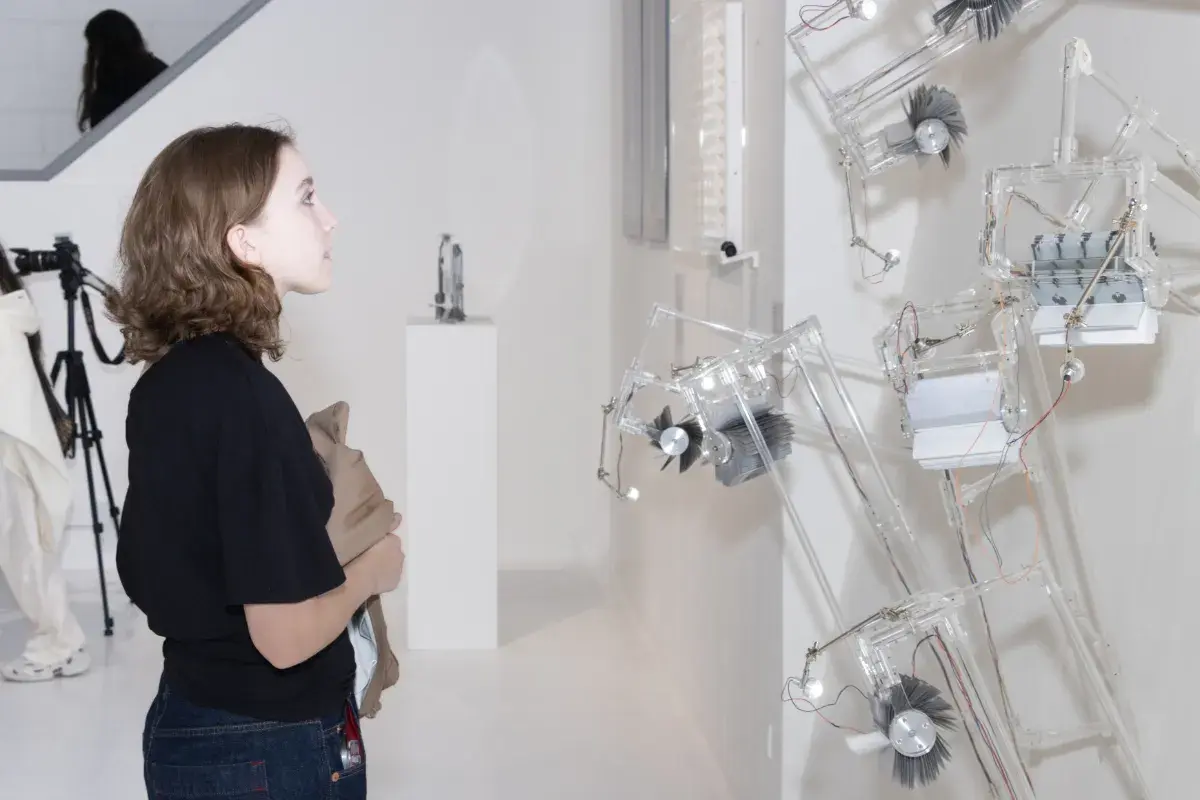
VENICE.- The international media art exhibition CYFEST 17 – Natura Naturans: Human Beings, Nature, Landscape brings to Venice a dialogue between historical avant-gardes, contemporary technologies, and environmental transformation. It explores what happens when nature is no longer simply represented, but becomes a process to be observed, activated, and even programmed. At CREA Cantieri del Contemporaneo on the island of Giudecca, the exhibition remains on view through 31 August 2026, bringing together international artists and works from the Frants Family Collection in a setting where painting, movement, light, sound, algorithms, and technological systems become tools for examining the relationship between human beings and the environment. Curated by CYLAND MediaArtLab in collaboration with Ca' Foscari University of Venice and the Center for Studies on the Arts of Russia, Central Asia and the Caucasus (CSAR), the exhibition takes its title from the philosophical concept of Natura Naturans, which describes nature as a generative force in a state of continuous transformation. Nature is therefore not presented as something static to be contemplated, but as a dynamic system in which matter, energy, time, and perception are constantly interacting. This concept provides the starting point for a dialogue between seemingly distant periods. On one side are the experiments of twentieth-century avant-garde and Russian and Soviet art, represented through the Frants Family Collection; on the other, contemporary artists working with automation, kinetic devices, video, artificial intelligence, algorithmic systems, and interactive technologies. The resulting exhibition reveals how questions first explored by the avant-gardes—concerning movement, light, matter, and perception—continue to resurface today through new technological languages. Among the works on view, Anna Frants' automated kinetic drawings transform light and movement into a generative process. Jaanika Peerna addresses the fragility of glaciers and the urgency of climate change through a poetic installation, while Tuula Närhinen imagines bird species capable of adapting to plastic-polluted environments, using fiction as a way of reflecting on the transformation of ecosystems.Wind becomes an invisible author in the work of Mariateresa Sartori, where an anemometer produces drawings positioned between natural phenomenon, chance, and human intervention. Elena Gubanova and Ivan Govorkov revisit the legacy of the avant-garde through a large-scale kinetic installation, while the internationally recognised collective AES+F explores embodiment, identity, and perception in the digital age through imagery suspended between the fairy-tale and the unsettling.The exhibition also features works by Andy Barrt, Alexandra Dementieva, Alexey Grachev, Sergey Kishchenko, Sergei Komarov & Lidiia Griaznova, Alexei Kostroma, Valery Koshlyakov, Linda Loh, Natalia Lyakh, Dmitriy Shishov, Eric Vernhes, and Mathieu Zurstrassen, expanding the conversation across different generations and geographical contexts within contemporary media art.CYFEST 17 extends beyond the exhibition space. Throughout its presentation in Venice, the festival has developed a programme of talks, performances, and screenings in collaboration with Ca' Foscari, bringing questions of art, technology, and ecology into the university environment. As part of Art Night Venezia, the 50th edition of LASER Talk CYLAND, dedicated to “hybrid ecologies,” brought together artists, curators, and scholars to discuss new forms of ecology emerging from the interaction of natural systems, technology, and cultural processes. The programme also included Andy Barrt's sculptural performance The Snow Flower of the North, created with Anton Ershov and Gabriele Grassi, as well as the third edition of Sleepless Video Art Night, an international overnight video art programme addressing environmental crises, migration, collective memory, and possible futures. Founded in 2007, CYFEST has developed into an international nomadic platform bringing together artists, curators, engineers, programmers, and researchers around the possibilities emerging at the intersection of art, science, and technology. The 17th edition, which began in Thessaloniki in late 2025, now continues in Venice, where Natura Naturans offers a particularly timely reflection: at a moment when landscapes are being reshaped by climate change and our experience of the world is increasingly mediated by technology, art can become a space for observing these processes and, perhaps, imagining alternatives.