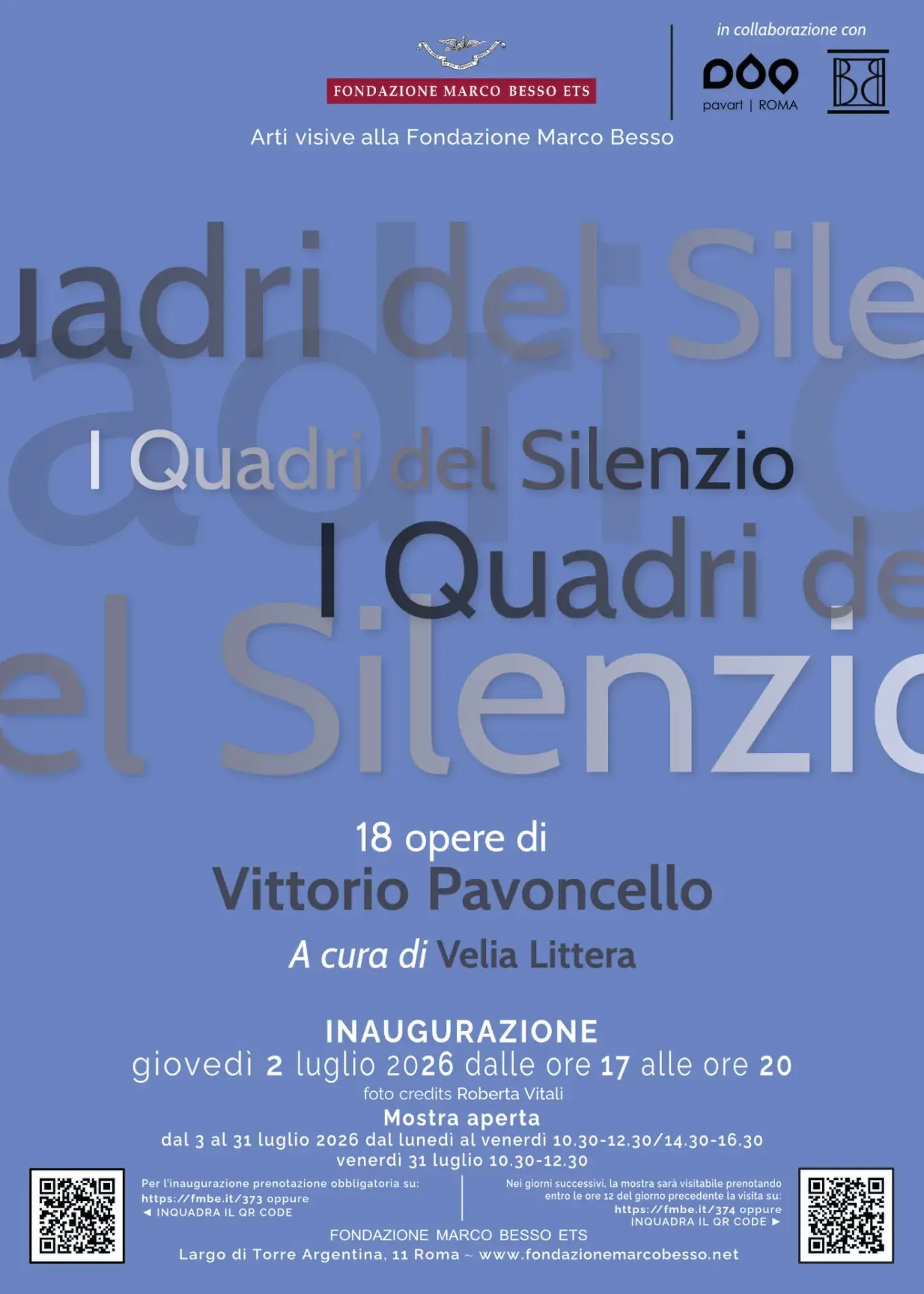
“The Paintings of Silence” is the symbolic title of a series of autonomous and deeply linked art works created by Vittorio Pavoncello. Each painting has its own individuality, its own measure and its own internal balance, however, observed as a whole, they reveal a common poetic tension, as variations of a pictorial meditation itself. Not a single work divided into parts, but a constellation of independent presences that find their deepest consonance in reciprocity and dialogue.
In these paintings Vittorio Pavoncello relies on an essential grammar, intense and enveloping chromatic fields welcome within them lighter and brighter surfaces, dense with matter and traversed by slight traces of the pictorial gesture. The forms do not aspire to geometric perfection, they retain a deliberate irregularity, a slight instability that makes them alive, removing them from any formal rigidity, and emerge as discrete apparitions, presences that seem to inhabit the canvas without ever claiming to dominate it.
Furthermore, a thin and vibrant texture emerges on the white surfaces which, while remaining entrusted to the pictorial material, evokes the visual languages of contemporary times, almost an algorithmic writing or the memory of indecipherable codes. A texture that recalls, in the distance, the logic of the QR code and opens up the space of imagination, suggesting how even abstraction can take place in infinite possibilities of seeing.
If each art work guards its own autonomy, it is however as a whole that the deepest meaning of the title is manifested. The silence evoked by this series of paintings does not coincide with emptiness, nor with absence or with simple silence. It is rather a condition of presence, a form of attention, an inner space that allows things to appear without fanfare. Silence is not opposed to the world, but represents a different way of experiencing it.
Each painting offers a different nuance, a particular inflection, a different intensity. As in a musical composition, where each movement has its own autonomy but participates in the same architecture, so these works constitute as many declinations of a unitary research. Silence then emerges as an experience that is slowly constructed in the transition from one work to another.
The strength of this series of paintings lies in its ability to subtract rather than accumulate. In a time dominated by the overabundance of images and the continuous acceleration of the gaze, Vittorio Pavoncello chooses an opposite path, that of measurement, slowness, permanence.
The pictorial material does not seek spectacular effects, but a more collected and meditative quality of seeing. Each canvas invites patient contemplation, a form of visual listening in which even the slightest vibrations of color and light acquire meaning for the observer.
The paintings of silence are thus configured as a reflection on the possibility of preserving a space of awareness within contemporary complexity, not an escape from the noise of the world, but a search for a necessary distance, a pause that restores depth to the experience. Because silence, rather than denial of speech or absence of sound, is perhaps the condition that makes listening possible again.
And perhaps this is precisely the most precious quality that these works seem to preserve, the ability to remember that there is a form of presence that does not need to impose itself, a light that does not pretend to dazzle and a stillness that does not coincide with immobility, but with a more intense and conscious participation in the world.