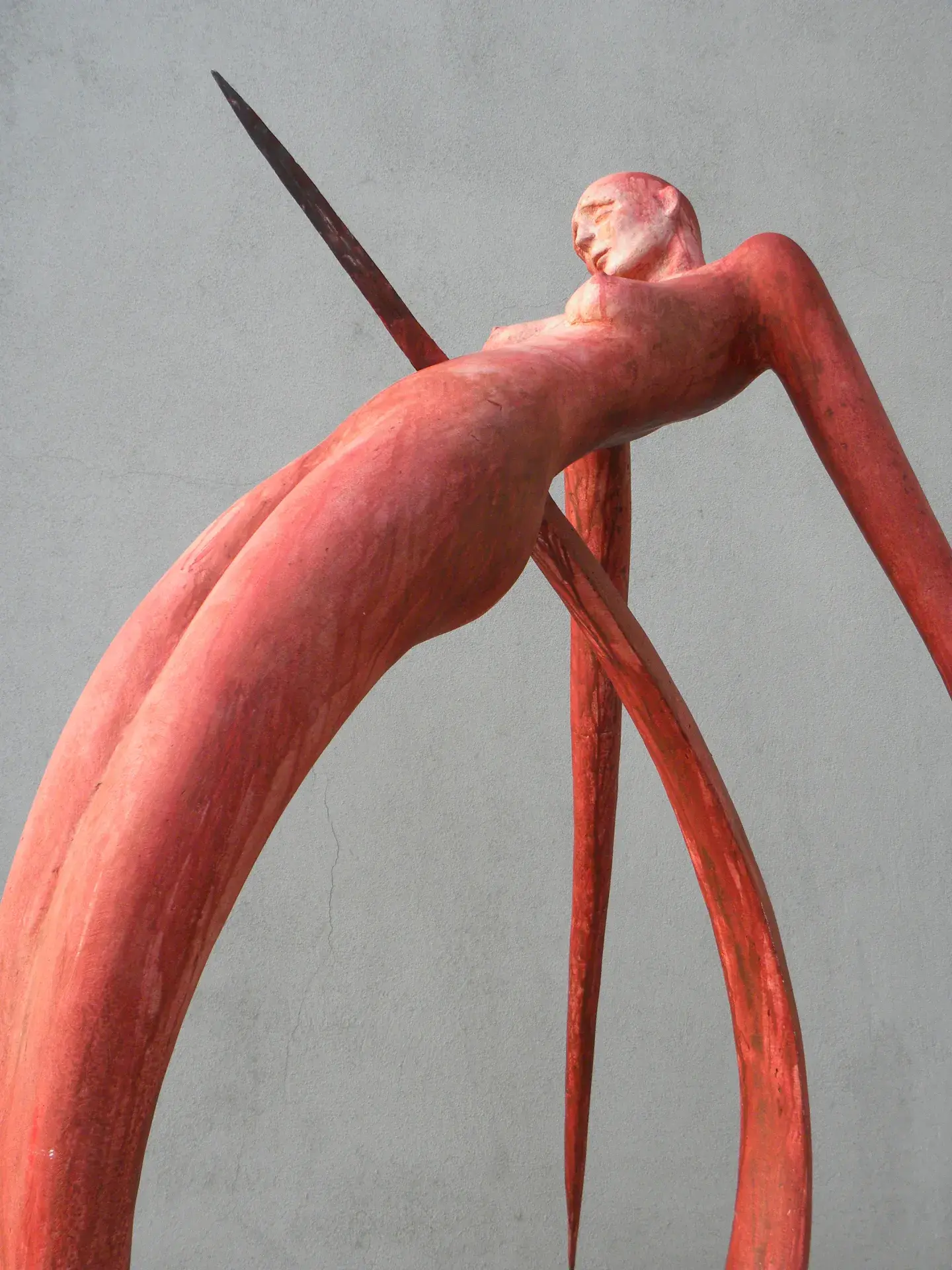
MEDEA Fragments of Memory is a solo exhibition by Tamara Kvesitadze, presented by Eka Enukidze and Hervé Mikaeloff, hosted at Palazzo Bragadin in Venice from 9 May to 31 October 2026.
The project takes shape as an installation environment where sculpture, sound, architecture, and memory intertwine in a powerful reflection on the fragility of identity, the trauma of separation, and the processes of individual and collective transformation. At the center of the exhibition stands the figure of Medea, removed from the traditional tragic narrative and reimagined as a contemporary symbol of exile, displacement, and mutation. More than a mythological character, Medea becomes an interpretative threshold through which to read cultural tensions, fractured memories, and unstable forms of belonging. The reference to Colchis, the territory linked to the myth and to the artist’s Georgian origins, opens a reflection on the symbolic geographies of Eastern Europe and the historical layers that still shape the present. Within the exhibition, Venice itself assumes a central role as a liminal city suspended between preservation and disappearance, historical splendor and contemporary fragility. This tension is translated into a modular urban model that repeatedly emerges and dissolves, evoking a city in constant redefinition. Red and blue paper surfaces marked by fractures, accumulations, and incisions appear as sensitive archives of time: not simple images, but material traces of what remains, resurfaces, or vanishes. The kinetic sculptures introduce a bodily and temporal dimension that deepens the viewer’s experience. In Reptile, a hybrid structure connecting floor and wall, the reptile becomes an archaic symbol of survival and metamorphosis, a kind of backbone of memory capable of carrying trauma and regeneration. In Whirling Woman, continuous rotational movement transforms the body into circular energy, freeing it from linear narrative and suggesting a condition of permanent exile, both internal and historical. A fundamental element of the exhibition is the soundtrack created by Soundwalk Collective, with the composition Medea by Stephan Crasneanscki and Simone Merli. Built from radio waves, environmental recordings, and vocal fragments from the Black Sea region, the soundscape creates a fragmented and immersive acoustic environment that does not simply accompany the visual experience, but destabilizes and expands it into perceptual space.
More than a traditional exhibition, Medea: Fragments of Memory presents itself as a sensory and mental experience in which visitors are invited to confront what escapes linear narration. Memory appears not as a stable archive, but as a living, discontinuous process in constant rewriting. Through a language combining matter, movement, and sound, Tamara Kvesitadze creates a powerful work on identities in transit and on the invisible traces the past continues to leave in the present.