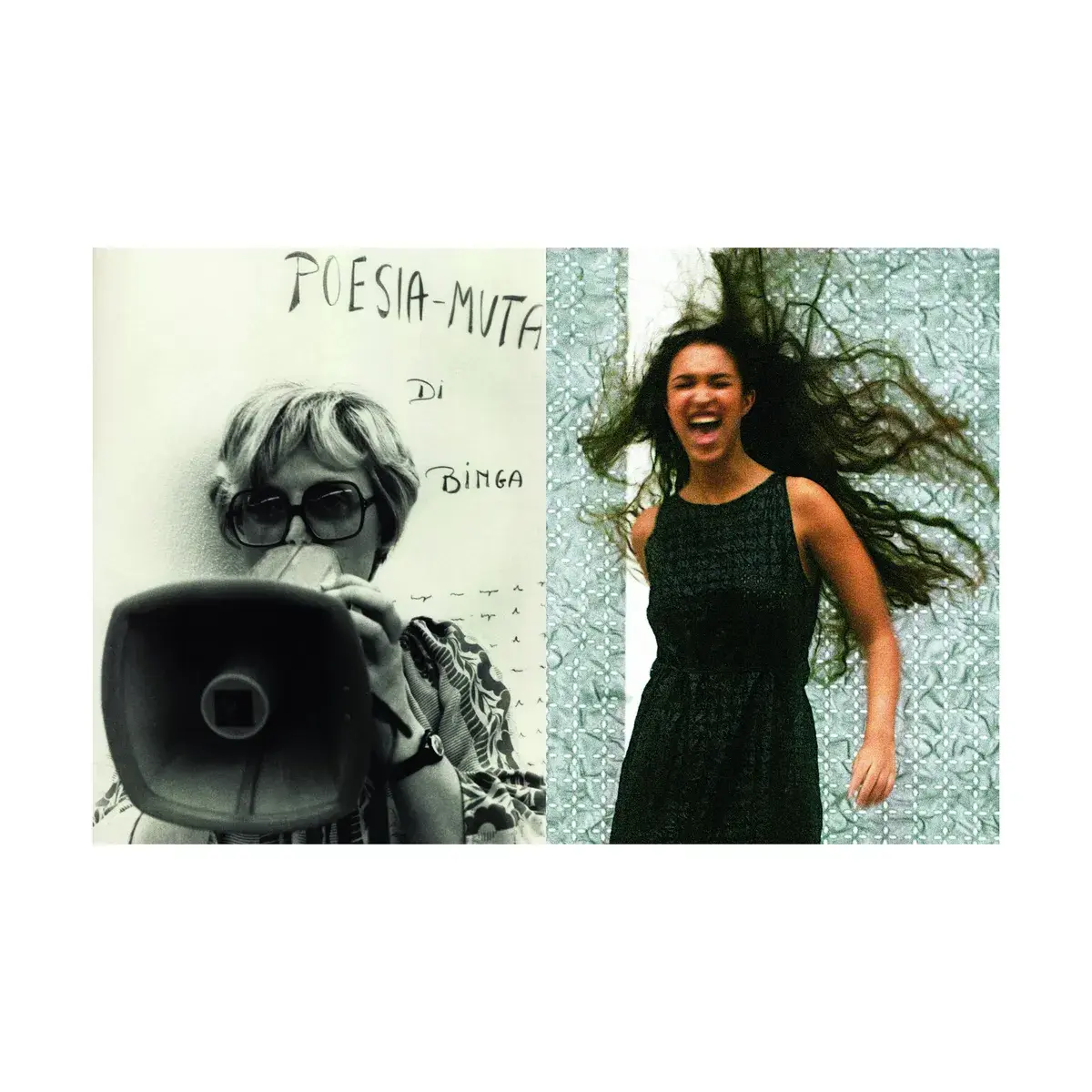
Maria Calderara continues her exploration of cross-language contamination, which has become the distinctive hallmark of her work, also in the FW 2026/27 collection inspired by the poetics of Tomaso Binga (Bianca Pucciarelli Menna, born in Salerno in 1931).
The collection #WWWWOMANWORDWRITINGFW26/27 will be presented on Friday, February 27, at 6:30 pm, at SPAZIO maria calderara in Milan (via Lazzaretto, 15). The exhibition project framing the presentation of the collection will be open to the public until March 13, 2026.
“From a conceptual point of view,” Calderara states, “#WWWWOMANWORDWRITINGFW26/27 stands in continuity with Binga’s artistic and intellectual research, who since the 1960s, through visual poetry, the body, and the word, has developed a strongly political practice aimed at denouncing the endemic exclusion of women from the art system.”
In this collection, subtle and refined references allow the artist’s works to enter into dialogue with the garments through applications integrated with elegance and expertise. Nothing is displayed or shouted; the intention is not to illustrate Binga’s work in a didactic manner, but to traverse it by adopting its method: the subtraction of meaning, rebellion against dogma, and the centrality of the body as a narrative tool. The result is an open system in which each element is conceived to be freely interpreted. Volumes, materials, and colors overlap without hierarchy, in a constant possibility of rewriting. Modular garments, adjustable through laces and elastics, are designed to adapt to different body types and postures. Alongside recurring solutions such as the puppet dress, voluminous skirts, and raw-cut deconstructed coats, wide trousers with pockets introduce a new construction this season. Derived from masculine tailoring, sleeveless jackets become women’s vests enriched by a dynamic intervention on the back. The asymmetrical and removable tie transforms from a quintessential formal accessory into a changeable and imaginative detail, while short jackets with extra-long sleeves become functional shoulder covers suitable for multiple uses.
Binga’s desemanticized writing is further stylized and interpreted through the insertion of small white felt rectangles forming a dashed pattern on dresses and jackets which, when worn together, build a graphic discourse in constant evolution. Binga’s words also extend into jewelry: those extracted from the epistolary correspondence of the work Ti scrivo solo di domenica (1977–1978) become engraved matter on small metal plates applied to necklaces. Bijoux made from heterogeneous materials—ranging from Murano glass and pearls to gold-laminated jersey chains—narrate a play of contrasts between traditional femininity and conceptual incisiveness.
Crumpled felt, felt fabric, raw cotton, and eco-leather worked to evoke the iconic Carta da parato (1976–1977) by the artist testify to Calderara’s constant and precise investigation of textiles. Added to this is the artist’s signature: the “Bi,” multiplied and repeated in different sizes on knitwear and trousers, becoming a module, a visual rhythm, almost an emulation of the weave of a men’s fabric. The palette moves between white, black, and gray, but is also crossed by the gold of chiné, giving the surfaces a nuanced and irregular chromatic effect. And then red—intense and structural—a recurring motif in the designer’s creations.
“The manual work employed in the making of the collection,” Calderara continues, “directly recalls the historical removal of female artistic labor and its marginalization. It is the same mechanism that led Bianca to adopt a male name, clearly revealing how access to artistic recognition was, and in part still is, profoundly marked by gender disparity.” This concept takes shape in an essential dress reduced to a rectangular structure, crossed by an opening for the head and two for the arms, on which the photographic diptych Bianca Menna and Tomaso Binga. Oggi spose (1977) is printed. Designed to be worn on both sides, the garment invites a conscious play of identity reversal, challenging consolidated stereotypes.
The exhibition project accompanying the presentation of the collection is realized in collaboration with the Archivio Tomaso Binga, the Tiziana Di Caro Gallery, and the Frittelli Arte Contemporanea Gallery.
Accompanied by a critical text by Francesca Interlenghi, it brings together some of the artist’s most significant works, including the polystyrene Mare (1974), works from the series Grafici di storie d’amore (1972–1973), the emblematic Scrittura Arrampicata (1976), and several canvases from the more recent series Lacrime di Sirena (2017–2020). The exhibition is completed by quotations from foundational works such as Vorrei essere un vigile urbano (1995), Diario romano 1895–1995 (1995–2020), and references to the seminal work Alfabetiere murale (1976).
These are traces and clues that guide the viewer’s gaze and suggest connections between the material of fashion and that of art, opening a fluid space of interpretation where disciplines contaminate each other and boundaries become porous.
The presentation of the collection at SPAZIO maria calderara (via Lazzaretto 15, Milan) will be open to the public. The venue will subsequently be open from March 2 to March 13, 2026, Monday to Friday, from 2:00 pm to 6:00 pm. Free admission. For information: www.mariacalderara.it.