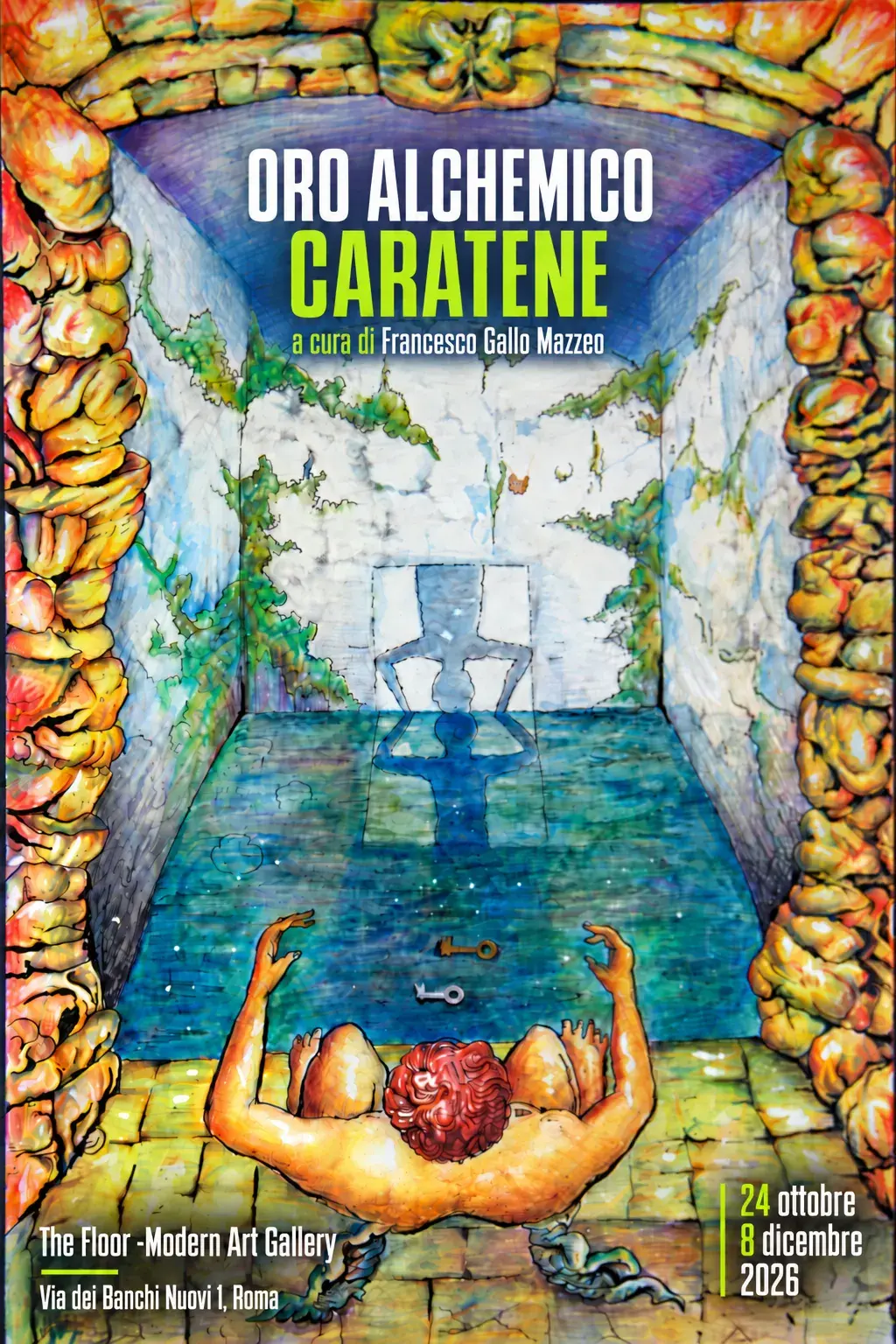
Philosopher’s Gold opens onto Caratene’s visionary world: a shifting terrain of memory, myth, symbols and metamorphosis, where images resist fixed meanings and seem to hover between revelation and disappearance.
Rather than unfolding as a linear narrative, the exhibition takes the form of an initiatory passage. Hybrid figures, bodies, signs and esoteric echoes emerge and dissolve within a visual field in constant transformation, where the familiar is continually displaced by something stranger, darker, more elusive.
Alchemy here is not a theme but a process. Caratene brings together opposing forces — light and shadow, eros and thanatos, irony and unease, the sacred and the grotesque — allowing them to remain unresolved. Meaning is generated through tension, collision and transformation.
The works form an inner cartography, or perhaps an unstable encyclopedia of images, memories and intuitions. Nothing is fully explained. Symbols appear as traces rather than answers, inviting the viewer to move through them by association, instinct and recognition.
In Philosopher’s Gold, the image becomes a threshold: a place where personal memory and archetypal forms, lived experience and inner vision, continuously exchange roles. What emerges is not a closed system of meanings, but an invitation to cross a boundary — and to allow the act of looking itself to become a form of transformation.